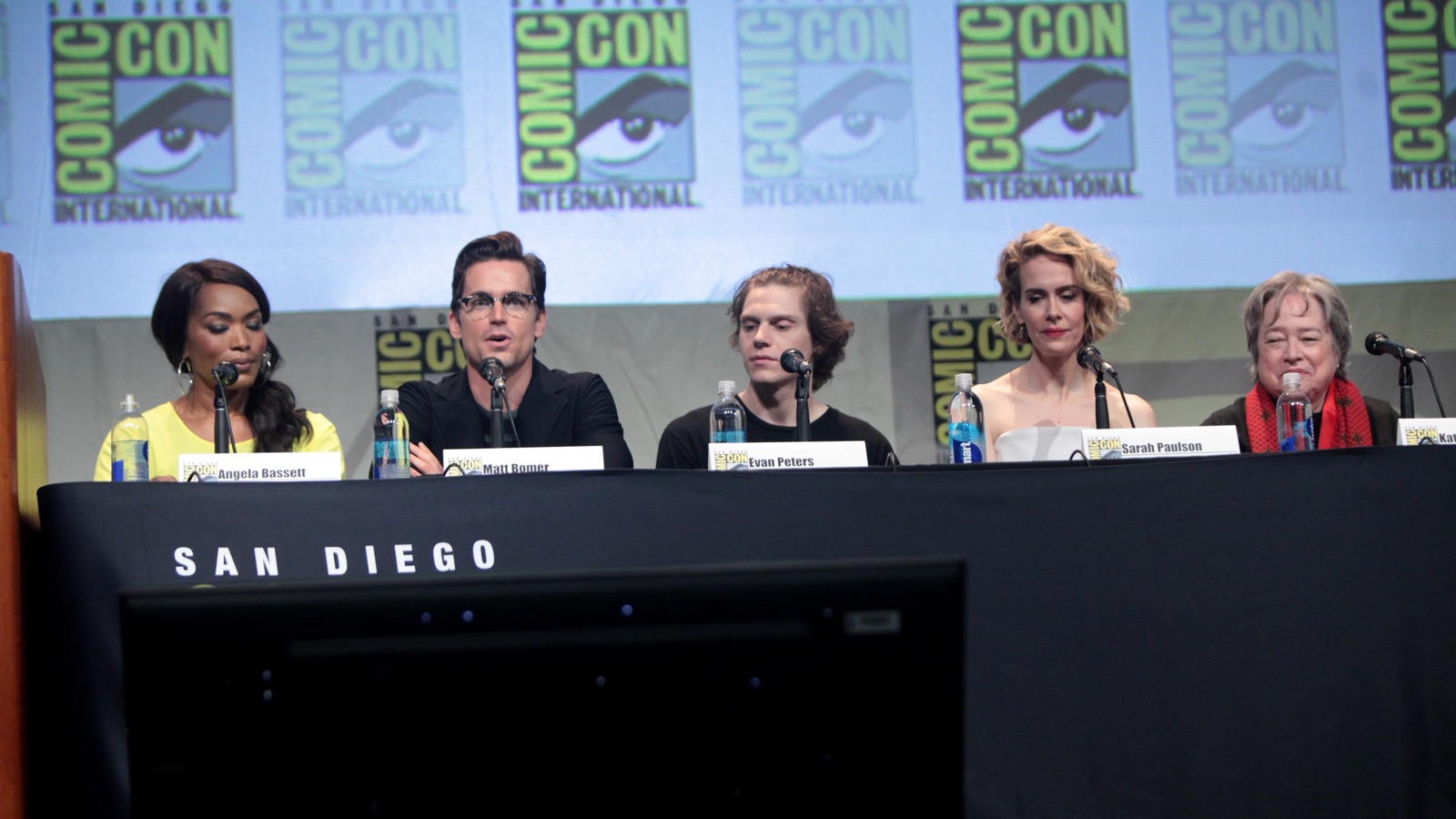
What is an anthology series in television?
An anthology series tells separate stories under one title, but that can mean a new story every episode or a complete reset each season. Here is how the format actually works.
In this article13 sections
Some TV shows ask you to remember years of relationships, mysteries and cliffhangers. An anthology series can do almost the opposite: it keeps the series title, but gives you a new story to enter.
That sounds simple until you notice that Black Mirror, American Horror Story and Fargo are all routinely described as anthologies even though they do not reset in exactly the same way.
The useful definition is therefore broader than “every episode has different characters”. An anthology series is a television series built around separate narrative units. A complete story may last one episode, several episodes or an entire season before the series moves to another story.
What connects those stories can be a genre, theme, tone, fictional universe, creative team or simply the title under which they are presented.
Anthology series: the quick answer
An anthology series is a show that presents multiple distinct stories instead of following one continuous main narrative from beginning to end.
The two most common forms are:
- Episode-to-episode anthology: each episode tells a largely self-contained story with its own central characters and conflict.
- Season-to-season anthology: one story runs across a full season, then a later season starts a substantially new story, usually with different characters, setting or central conflict.
Some anthologies are extremely strict about that separation. Others keep small connections between stories, reuse actors or reveal that apparently independent stories share a world.
That does not automatically stop them from being anthologies. The important question is whether each installment is designed to function as its own main story rather than merely as the next chapter of one continuing plot.
What does “anthology” mean in television?
The word anthology originally describes a collection of selected works. Television applies the same basic idea to storytelling: several works are gathered under one series identity.
That identity can be surprisingly loose. The stories may share little more than a genre or theme. A horror anthology might tell unrelated supernatural stories. A science-fiction anthology might repeatedly explore technology, society or the future without following the same protagonist.
Other anthologies have stronger connective tissue. Stories can take place in the same fictional universe, share recurring locations or hide references to one another.
So an anthology is not defined by total isolation. It is defined by the way the show divides its storytelling into substantially independent units.
Episode-to-episode anthologies
This is the classic version of the format: one episode, one main story.
A viewer can often start with an episode because its central characters, problem and resolution are introduced inside that episode rather than carried over from a long serialized storyline.
Black Mirror is a modern example. Netflix describes its episodes as stand-alone stories, even though the series also contains references and Easter eggs that can connect different episodes to a broader shared world.
That combination shows why “anthology” does not have to mean “nothing is ever connected”. The stories can acknowledge one another while remaining independently understandable.
FX's American Horror Stories uses a similar episode-focused idea: individual installments can tell different horror stories under the same series banner.
Season-to-season anthologies
Modern television also popularised a larger version of the same idea: instead of resetting after one episode, the story resets after a season.
A season can therefore behave almost like a long film or limited series. It has time to develop recurring characters, multiple episodes and a season-long arc, but the next season can move somewhere else and begin again.
American Horror Story helped make this structure mainstream. The series was conceived as an umbrella under which each season could tell a new horror story, often in a new setting or time period.
Fargo follows the season-to-season model as well. Different seasons build complete crime stories around new combinations of characters while preserving the broader identity and tone of Fargo.
True Detective offers another familiar version of the structure: later seasons introduce a new central case and a new group of investigators rather than continuing one detective team's story indefinitely.
Can an anthology reuse the same actors?
Yes. Actors and characters are not the same thing.
An anthology can bring the same performer back in a completely different role. In that case, the production gains a familiar face without necessarily continuing the previous character's story.
This became particularly visible in season-based anthologies, where members of an ensemble may return while the setting, period and characters change.
The reverse is also possible: a mostly anthology-style series can occasionally bring back an existing character or connect two previously separate stories.
That is why casting alone is a bad test for deciding whether a series is an anthology. Look at the continuity of the story and characters being portrayed, not simply the names of the actors in the credits.
Can anthology stories share the same universe?
They can.
A shared universe does not automatically turn separate stories into one serialized narrative. Two installments may reference the same company, technology, historical event or location while still telling complete stories about different characters.
Black Mirror is useful here again. Netflix has documented references between otherwise stand-alone episodes. Those connections reward viewers who notice them, but they normally do not require you to watch every previous episode to understand the next story.
There is a spectrum. At one end are completely isolated stories. At the other are anthology installments with enough recurring continuity that the boundary starts to become debatable.
The more an installment requires knowledge of earlier stories, the less useful it becomes to describe it as fully independent.
Anthology series vs an ordinary episodic show
This is where the term is often misunderstood.
A normal procedural can have a new case, patient, criminal or problem every week without being an anthology.
The difference is the continuing core.
If the same main characters return every episode, their relationships develop over time and an ongoing storyline links the episodes together, the show is usually an episodic or procedural series rather than an anthology.
In an anthology, the main narrative itself resets between installments.
So “story of the week” does not automatically mean anthology.
Anthology series vs limited series or miniseries
A limited series normally tells one main story across several episodes and is designed as a finite run.
An anthology contains multiple distinct stories under a continuing series identity.
That creates an important difference:
- a six-episode drama telling one continuous story can be a limited series without being an anthology;
- a show that returns with a substantially new story for another installment or season can operate as an anthology;
- a season of a seasonal anthology can itself feel structurally similar to a limited series.
This overlap is one reason television awards sometimes group limited and anthology programming together even though the concepts are not identical.
Why can the official definitions seem inconsistent?
Because “anthology” can mean slightly different things depending on context.
For normal discussion of television formats, both episode-based shows and season-based shows are commonly described as anthologies.
Awards organisations may need a narrower technical definition to decide which programmes can compete in a particular category.
For example, the Television Academy's current Emmy rules define an Anthology Series in episode-level terms: individual episodes tell complete, non-recurring stories without an ongoing storyline or main characters continuing into later episodes.
That is useful for Emmy eligibility. It does not erase the broader industry use of phrases such as seasonal anthology, which television creators, networks and the Television Academy's own editorial coverage have also used for shows such as American Horror Story and Fargo.
So when two sources appear to disagree about whether something is an anthology, first check whether one of them is using an awards-category definition rather than describing the storytelling format in general.
Why do creators use the anthology format?
The format gives a series room to reinvent itself without throwing away its entire identity.
A new installment can change:
- characters;
- setting;
- time period;
- genre or subgenre;
- visual style;
- central conflict;
- cast.
That makes it possible to tell a story with a real ending while still leaving the larger series open for another idea.
It can also let viewers enter without catching up on years of previous plot. For actors and filmmakers, the format creates opportunities to approach a familiar series from a different direction rather than repeating the same character arc indefinitely.
The trade-off is that an anthology has to earn the audience's investment again. A viewer who loved one season's characters may discover that the next season deliberately leaves them behind.
Can you watch an anthology series out of order?
Often, but not always.
For a strict episode-to-episode anthology, order may matter very little. Black Mirror is built around stand-alone stories, so viewers can generally choose an episode without needing the earlier plots first.
For a seasonal anthology, it is often possible to watch one season independently because the central story resets. But there can still be callbacks, shared-universe details or returning characters.
A practical rule is:
- New story and new characters every episode: usually safe to sample episodes individually.
- New story every season: usually watch that chosen season from its first episode, even if you skip earlier seasons.
- Recurring characters or obvious crossover: check whether previous installments add important context.
“Anthology” should therefore be treated as a description of structure, not a guarantee that viewing order can never matter.
Examples of anthology formats
- Black Mirror — Episode-to-episode: the main story and central characters reset.
- American Horror Stories — Episode-to-episode: the primary horror story resets.
- American Horror Story — Season-to-season: the main setting, story and character roles reset.
- Fargo — Season-to-season: the main crime story and central cast of characters reset.
- True Detective — Season-to-season: the central investigation and lead characters reset.
The table also shows why “anthology” is a family of storytelling structures rather than one rigid template.
A simple way to recognise an anthology
If you are not sure whether a show is an anthology, ask four questions:
- Does the main story finish before the next installment begins?
- Does the next episode or season introduce a substantially new central story?
- Can the series replace its main characters without breaking its basic format?
- Is the continuing identity mostly a theme, world, genre or series banner rather than one uninterrupted plot?
The more often the answer is yes, the more useful the anthology label becomes.
The key idea is not simply that a show changes things. Every long-running series changes. An anthology is designed around starting another story.
Editorial references
Sources
-
ANTHOLOGY SERIES | English meaning
Accessed 2026-08-11
-
Emmy Rules & Procedures
Accessed 2026-08-11
-
15 Best 'Black Mirror' Episodes For Every Dystopian Mood
Published/updated 2026-03-04 Accessed 2026-08-11
-
Inside Out
Published/updated 2018-07-26 Accessed 2026-08-11
-
So Many Stories to Tell
Published/updated 2017-08-04 Accessed 2026-08-11
-
True Detective
Accessed 2026-08-11
-
American Horror Stories
Accessed 2026-08-11
More from Watchmora Journal

Inception ending explained: what it really means
Inception cuts to black before Cobb's spinning top gives us a final answer. Mechanically, the ending stays ambiguous. Emotionally, Cobb has already made his decision.
Read story
Don't know what to watch? Try searching Watchmora like this
You do not need to know a movie title to start searching. A mood, genre, format or even something you do not want can be enough to narrow the catalogue into something useful.
Read story
Where was Lost filmed? Key filming locations
The mysterious island in Lost was fictional, but much of what viewers saw was real Oʻahu. Beaches, valleys, camps and city buildings across the island repeatedly became completely different parts of the show.
Read story
Four mystery series for four very different moods
Some nights you want a mystery that feels clever and easy to watch. Other nights you want something bleak, forensic or completely outside the usual police formula. These four series cover very different moods.
Read story