Don't know what to watch? Try searching Watchmora like this
You do not need to know a movie title to start searching. A mood, genre, format or even something you do not want can be enough to narrow the catalogue into something useful.
In this article9 sections
Sometimes choosing what to watch would be easier if you knew the name of the thing you wanted.
Usually you do not.
You know that you want something tense but not exhausting. Or science fiction that does not feel bleak. Maybe you want a detective series, but not another supernatural one. Perhaps all you really know is that tonight feels like a 1990s crime movie.
That is the useful part of Watchmora Search: you do not have to begin with a title. You can begin with the shape of the evening instead.
The trick is not to write the longest possible prompt. It is to give Search the few details that actually change what you would choose.
Start with the feeling, not the title
A genre is useful, but it is often not enough.
Two science-fiction films can have almost nothing in common emotionally. One can be cold and disturbing; another can be funny, hopeful or adventurous. If the mood is the part you actually care about, say it.
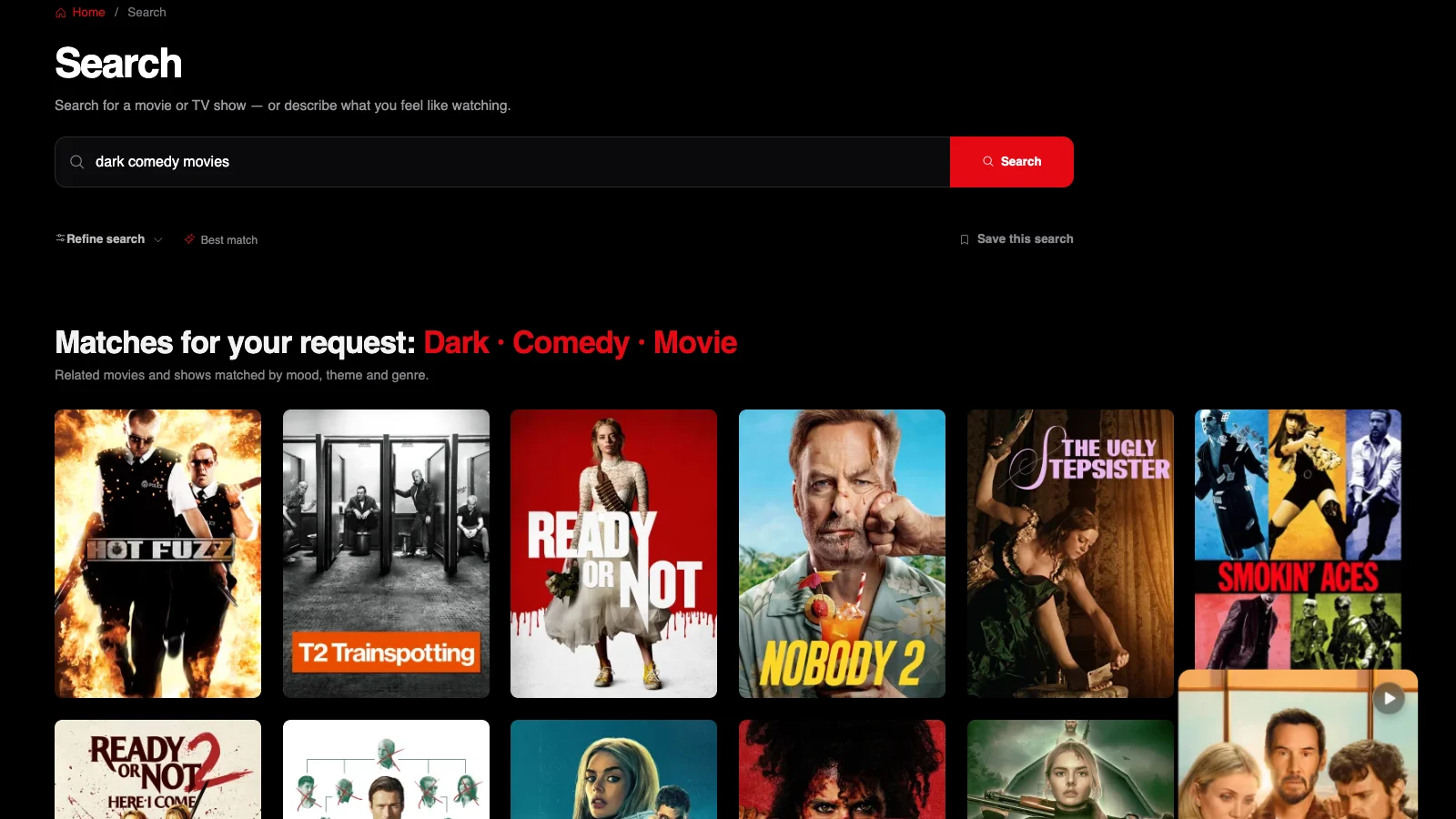
For example, the current Watchmora Search handles this query well:
“dark comedy movies”
That small extra word gives the search more direction than simply typing “sci-fi”, “comedy” or “horror”. You are not only saying what kind of story you want. You are giving it an idea of how you want that story to feel.
Give Watchmora two useful pieces of information
The most useful queries are often surprisingly short.
Instead of describing an entire imaginary film, combine two constraints that genuinely matter.
One can describe the kind of story. The other can describe the format, tone or audience experience.
For example:
“uplifting animated movies”
Here the second part matters because “detective”, “space”, “animation” or another theme can exist across films and series. Telling Search what format you actually want removes a large group of answers you were never going to choose.
Look at the shelf, not for one perfect answer
A discovery search works best when it gives you a useful shelf, not when it pretends there is one mathematically correct film for your evening.
That is an important difference.
For “dark comedy movies”, these are a few of the titles Watchmora currently surfaces:
The point is not that one of these titles is permanently the “best result”. Search ranking and the catalogue can change.
The useful part is that you have already moved from thousands of possible movies and series to a small group that shares the thing you actually asked for.
Tell it what you do not want — when that actually helps
Sometimes the thing ruining your search is not what you want. It is the one direction you definitely do not want to go.
If the current Search can clearly respect that distinction, say it directly.
For example:
“crime movies without horror”
This is more useful than endlessly adding positive adjectives when one unwanted element is the real deal-breaker.
Negative intent is also where you should pay attention to the actual results rather than assuming the wording worked. If unwanted titles still dominate the page, simplify or rephrase the search instead of trusting the query blindly.
An era can be more useful than another genre
An era can completely change the kind of film or series you are looking for, but only when the search can reliably interpret the period.
If a decade-based query currently produces mixed or inaccurate results, use Watchmora's normal catalogue filters or broader discovery tools instead of pretending the natural-language phrase worked perfectly.
A product guide is more useful when it admits where a search needs simplifying.
More detail is not always better
Natural-language search makes it tempting to describe the perfect imaginary movie in one enormous sentence.
That can eventually work against you.
If you ask for a “slow atmospheric 1990s detective series in a small coastal town with no fantasy, no comedy and episodes under forty minutes”, the catalogue may simply not contain enough titles that satisfy every condition.
When a search becomes weak, simplify it.
Remove the least important condition first.
Instead of trying to make one query carry every preference you have ever had, ask what would genuinely make you reject a result tonight.
If runtime does not really matter, remove it. If the decade was only a preference, drop the decade. Keep the two or three things that actually define the mood.
Use Collections when you want to browse a known idea
Search is useful when your request is specific or oddly shaped.
But sometimes you already know the shelf you want.
If you simply feel like time travel, revenge stories, AI and robots, detectives or dystopian futures, a curated Watchmora Collection can be faster than describing the same idea from scratch.
Collections are especially useful when you want to browse and compare rather than narrow aggressively.
Search asks: “What fits this request?”
A collection asks: “What interesting things live inside this idea?”
Neither is automatically better. They solve different versions of the same problem.
View all Watchmora Collections.
Use recommendations when you want to give up some control
Search starts with what you ask for right now.
Personal recommendations work from what Watchmora already knows about your taste through the signals available to your account.
That makes recommendations more useful on nights when you do not even want to formulate a query.
If you have already rated titles or built enough taste history, letting Watchmora suggest something can be easier than deciding whether tonight is “dark mystery”, “slow crime” or “funny science fiction”.
Search gives you more control over the immediate request. Recommendations can do more of the choosing for you.
Open your Watchmora recommendations.
Search like a person, not a database
You do not need to know Watchmora's internal genre names, filters or database structure.
Start with the words you would use if somebody sitting next to you asked:
“So what do you actually feel like watching?”
Maybe the answer is “something uplifting in space”. Maybe it is “a dark detective series”. Maybe it is just “a 90s crime movie”.
That is enough to start.
If the results are too broad, add one useful condition. If they become too narrow, remove one.
The goal is not to write the perfect search prompt.
The goal is to stop scrolling through things you never wanted and get to a small enough group that choosing a movie or series becomes easy again.
More from Watchmora Journal

Inception ending explained: what it really means
Inception cuts to black before Cobb's spinning top gives us a final answer. Mechanically, the ending stays ambiguous. Emotionally, Cobb has already made his decision.
Read story
Where was Lost filmed? Key filming locations
The mysterious island in Lost was fictional, but much of what viewers saw was real Oʻahu. Beaches, valleys, camps and city buildings across the island repeatedly became completely different parts of the show.
Read story
Four mystery series for four very different moods
Some nights you want a mystery that feels clever and easy to watch. Other nights you want something bleak, forensic or completely outside the usual police formula. These four series cover very different moods.
Read story
What is a retcon in movies, TV and comics?
A retcon changes how an established story is understood by adding, rewriting or removing information later. But not every surprise, reboot or continuity mistake is a retcon.
Read story