
Inception ending explained: what it really means
Inception cuts to black before Cobb's spinning top gives us a final answer. Mechanically, the ending stays ambiguous. Emotionally, Cobb has already made his decision.
In this article12 sections
Spoiler warning: this article explains the final scene of Inception and discusses major revelations from the entire film.
Christopher Nolan ends Inception with a question that looks almost ridiculously simple: does the spinning top fall?
Dom Cobb has finally returned home. He spins the metal top he has been using to test reality, hears his children outside and walks away from it. The camera stays behind. The top keeps turning, begins to wobble — and the film cuts to black before we see what happens next.
That missing second created one of modern cinema's most famous ending debates.
But the ending has two different questions inside it. One is mechanical: is Cobb awake or still dreaming? The other is emotional: does Cobb still need to know?
The film refuses to settle the first question completely. It gives a much clearer answer to the second.
Inception ending: the quick answer
At the end of Inception, Cobb and the rest of the team wake on the plane after completing the job inside Robert Fischer's dreams. The film strongly implies that Saito keeps his promise to help Cobb return to the United States without being arrested.
Cobb passes through the airport, is met by Miles and finally reaches his children.
Before going to them, he spins the top. Earlier in the film, Cobb uses it as a reality test: in a dream it can continue spinning without falling, while in waking reality it eventually loses balance.
The camera watches the top begin to wobble, but Nolan cuts to black before it falls.
So the strict answer is: the film never gives us visual proof of whether the top finally falls.
There are several clues that support the idea that Cobb really is awake. But the more important resolution is that he leaves the top behind. For the first time, confirming reality matters less to him than actually living in it.
What actually happens in the final minutes?
The final sequence begins after the team completes the inception inside Fischer's layered dream.
Fischer has reached the emotional conclusion the team wanted him to reach: instead of simply copying his father's life, he believes he should build something of his own. The job appears to have worked.
Cobb, meanwhile, has gone deeper. He enters limbo and finds Saito as an old man. Their conversation echoes the promise that brought Cobb into the job in the first place: Saito offered him a way home if Cobb could complete the inception.
The film does not laboriously show every mechanical step of their escape from limbo. Instead, it cuts from that encounter to the plane, where Cobb and the others wake.
Saito makes a phone call. When they arrive in Los Angeles, Cobb is allowed through immigration. The clear implication is that Saito has fulfilled his side of the bargain.
Miles meets Cobb at the airport and takes him home. Cobb sees his children outside, much as he has remembered them throughout the film — except this time they turn toward him and he finally sees their faces.
Cobb puts the spinning top on the table.
Then he does something more important than spinning it: he walks away.
What does the spinning top mean?
The top is the final scene's most obvious reality test, but it carries more emotional baggage than a normal totem.
It originally belonged to Mal.
When Cobb explains what happened to his wife, we learn that while they were trapped in limbo Mal locked away the knowledge that their world was not real. Cobb found that idea and planted another one in her mind: the conviction that her world was a dream and that she needed to wake up.
That inception worked too well. Even after returning to waking life, Mal could not let go of the belief that reality itself was another dream.
After her death, Cobb uses her spinning top to test his own reality.
That makes the object more than a clever piece of dream technology. Every time Cobb spins it, he is also repeating the obsession that destroyed Mal: is this world real enough to trust?
By the final scene, the top represents Cobb's need for certainty as much as it represents dream mechanics.
Does the top fall at the end of Inception?
We never see it fall.
We also never see it prove that it can keep spinning forever.
The final shot shows the top rotating on the table and beginning to lose some of its perfect stability. There is a visible wobble shortly before the cut to black.
That wobble is one reason many viewers read the ending as reality. Earlier examples of the top inside dreams establish the frightening idea of endless, unnatural spinning. The final top does not look perfectly stable.
But a wobble is not the same thing as watching it fall.
Nolan deliberately ends the shot before the physical test produces an answer. If the film wanted to certify waking reality mechanically, it could simply have stayed on the table for another moment.
It does not.
The audience is therefore left doing exactly what Cobb has stopped doing: staring at the top and demanding certainty from it.
Is Cobb still dreaming?
The film leaves that possibility open, but it does not treat every interpretation as equally supported.
There are reasons to think Cobb is awake. The top wobbles. Details involving his children differ from the repeated memory that has haunted him. Miles is present in the final sequence. And the entire dramatic structure has moved Cobb toward completing the job, confronting his projection of Mal and returning home.
There are also reasons viewers remain suspicious. Cobb has spent the entire film moving through realities that can imitate ordinary life. His own ability to distinguish those realities has repeatedly been questioned. And the one mechanical test the camera gives us is interrupted before completion.
Christopher Nolan has consistently protected that ambiguity rather than publicly reducing the ending to a simple answer.
In his 2010 interview with WIRED, Nolan explained that the film deliberately contains details that push viewers in different directions. He also made clear that satisfying ambiguity still needs to rest on a coherent underlying interpretation rather than being arbitrary.
In other words, Nolan has his own answer to what is happening. He simply does not make possession of that answer necessary for the audience to understand Cobb's ending.
The strongest clues that Cobb is awake
If you want to argue that the final scene takes place in reality, several clues are stronger than simply saying the ending “feels happy”.
| Clue | Why it supports reality | Why it is not absolute proof |
|---|---|---|
| The top wobbles | It begins to lose the perfect stability associated with endless dream-spinning. | The film cuts before we actually see it fall. |
| The children are not an exact copy of Cobb's memory | Nolan has specifically rejected the claim that the children are wearing exactly the same clothes at the end and confirmed that two sets of children were used. | Different details alone cannot prove that a scene is not a dream. |
| Miles is present | Michael Caine later recalled Nolan telling him that scenes containing his character were reality. | That is Caine's recollection of direction he received, not a rule explicitly taught to the audience by the film. |
| Cobb's story has reached its intended destination | The inception succeeds, Saito appears to honour the deal and Cobb finally confronts his guilt over Mal. | A satisfying dramatic resolution can still happen inside a dream. |
Taken together, those details make a waking-reality interpretation very reasonable.
But none of them changes the construction of the final shot: Nolan still chooses not to show the decisive fall.
What about Cobb's wedding ring?
The wedding ring is one of the most persistent fan observations surrounding the ending.
Viewers have noted a pattern in which Cobb can be seen wearing his wedding ring in a number of dream scenes while it is absent in scenes presented as waking reality. Because the ring is not visible on him during the final homecoming, the theory treats it as another clue that he is awake.
It is an interesting observation because viewers naturally look for something more reliable than the deliberately unfinished spinning-top test.
But it needs to be kept in proportion.
The film never introduces Cobb's wedding ring as an official totem. Nobody explains a rule that “ring means dream, no ring means reality”, and Nolan has not publicly presented the ring as the final key that solves the ending.
So the ring works best as supporting visual evidence, not as a secret answer that overrides the deliberately unfinished top shot.
Michael Caine's clue points toward reality
There is a stronger behind-the-scenes argument for the reality interpretation.
In 2018, Michael Caine — who plays Miles — recalled being confused when he first read the screenplay and asking Nolan which parts were dreams and which were reality.
According to Caine, Nolan gave him a simple piece of guidance: when Caine was in a scene, it was reality.
Miles appears in the final sequence.
Taken literally, that instruction would mean Cobb really has returned home.
It is a valuable clue because it comes from an actor describing direction he says he received directly from Nolan. But it should not be exaggerated into a formal law of the film. The audience is never given that rule on screen, and Nolan himself has continued to protect the ending's ambiguity.
So Caine's story pushes the evidence toward reality. It does not make the final image meaningless.
Why does Cobb walk away from the top?
This is the part of the ending Nolan has been much more willing to explain.
Earlier in the film, Cobb needs the top because he no longer fully trusts his own experience. His life has become organised around the possibility that reality might not be real.
That fear is inseparable from Mal.
In limbo, Cobb finally admits that the Mal he keeps encountering is only a projection. However vivid she feels, she is not his wife. He has spent years carrying guilt for what he planted in Mal's mind and allowing that guilt to invade every dream he enters.
Letting the projection go is part of returning to his own life.
That is why the final action matters. Cobb spins the top almost automatically — and then hears his children.
He could wait.
He does not.
He turns away from the object that has represented his anxiety about reality and goes to them.
Whether the top falls is still intellectually interesting to us. It is no longer emotionally necessary to Cobb.
What has Christopher Nolan actually said about the ending?
Nolan's own comments make the distinction between those two questions especially clear.
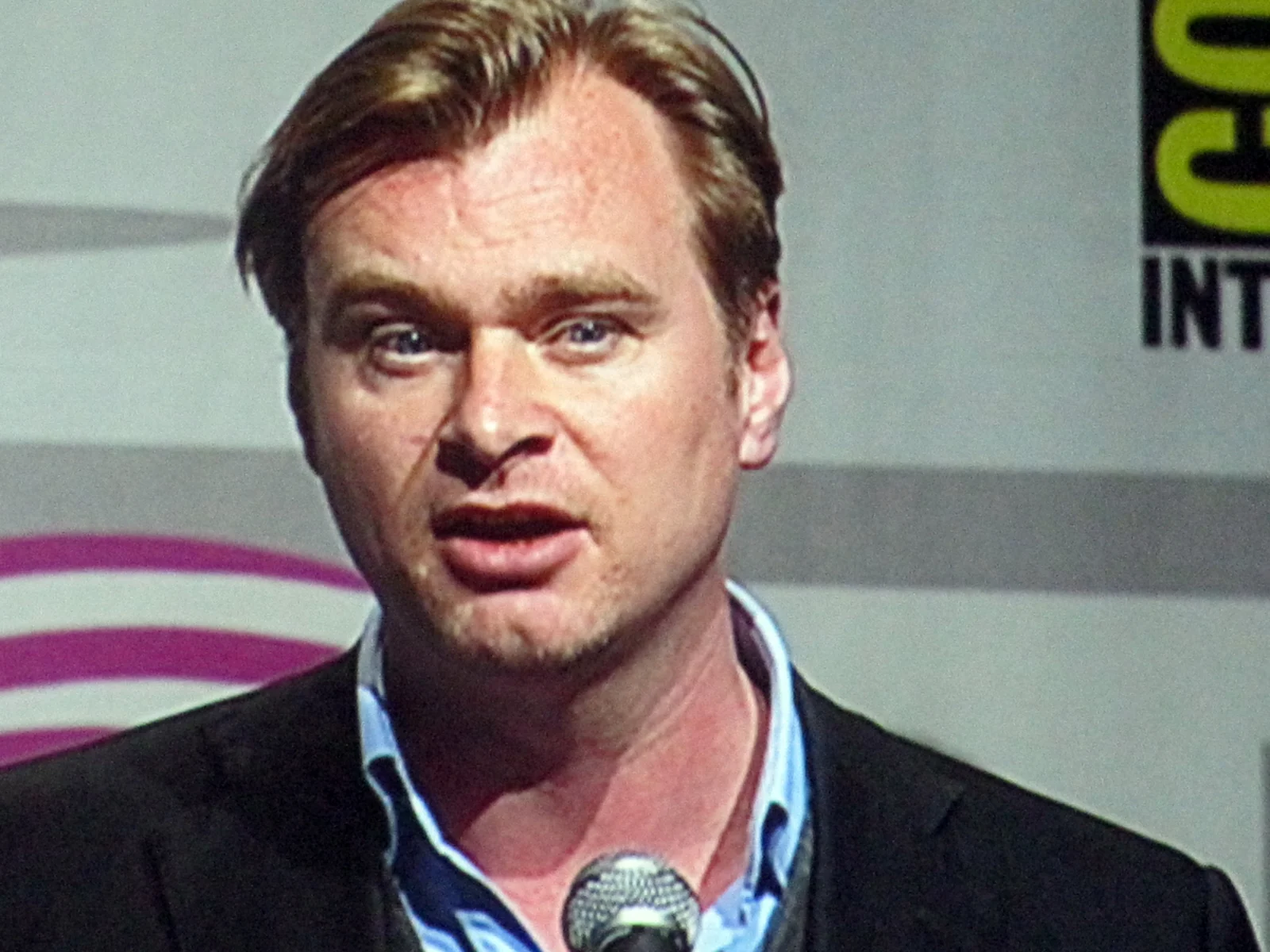
In his 2010 WIRED interview, Nolan refused to eliminate the ending's ambiguity. He said viewers were noticing details deliberately designed either to create ambiguity or push them toward one interpretation or another.
He also directly corrected one popular argument: the children at the end are not wearing exactly the same clothes, and two sets of children were used during production.
Most importantly, when discussing the final spinning top, Nolan shifted attention away from the object itself. The emotional point, he explained, is that Cobb is no longer looking at it.
Nolan also confirmed that he personally has an answer underneath the ambiguity. His approach is not “anything can mean anything”. He believes ambiguity works only when the filmmaker has a solid underlying interpretation and allows uncertainty to arise from the character's inability to know.
Five years later, during his Class Day address at Princeton University, Nolan argued for respecting and pursuing reality rather than treating it as inferior to dreams.
That broader point matters because it makes one simplistic interpretation difficult to defend: the ending is not merely saying that reality is irrelevant.
Cobb's achievement is not that truth has stopped existing.
It is that his life no longer has to freeze while he waits for absolute certainty.
What does the Inception ending really mean?
Inception spends most of its running time teaching us to distrust experience.
A convincing room can be a dream. Years of life can pass in limbo. A memory can become an environment. An idea planted deeply enough can feel as if it originated inside the person who received it.
Cobb responds to that uncertainty by trying to verify reality.
Mal responds to it catastrophically: once the idea that her world is unreal takes hold, no ordinary evidence can persuade her to live inside it.
The final scene puts Cobb beside the same danger.
He can keep asking the question forever.
Instead, he chooses participation over endless verification.
That does not mean the film is saying truth is irrelevant or that dreams and reality are literally identical.
It means Cobb's emotional recovery cannot depend on testing every experience until doubt becomes impossible.
His children are in front of him.
He chooses to be with them.
What does the ending leave unanswered?
The most famous unanswered question remains exactly where Nolan leaves it: does the top eventually fall?
The film also leaves room around several related questions:
- How much weight should we give the wobble before the cut?
- How much should Michael Caine's recollection of Nolan's on-set direction influence our reading?
- Is the wedding-ring pattern intentional evidence, or simply a visual detail viewers have turned into a rule?
- How reliable is a reality test inherited from Mal when Cobb's central problem is his own inability to let Mal go?
Those questions keep the ending alive without requiring us to invent secret dream levels or unsupported explanations.
The strongest interpretation does not need to pretend the ambiguity disappeared.
The final scene leans toward Cobb being awake, but Nolan deliberately withholds the mechanical proof. Emotionally, however, the ending is much clearer: Cobb has stopped letting the question control him.
The audience stays with the spinning top.
Cobb finally does not.
Editorial references
Sources
-
Q&A: Christopher Nolan on Dreams, Architecture, and Ambiguity
Published/updated 2010-11-29 Accessed 2026-09-01
-
Film director Nolan challenges seniors to 'chase your reality'
Published/updated 2015-06-01 Accessed 2026-09-01
-
Let Michael Caine Finally Explain the Ending of Inception Once and For All
Published/updated 2018-08-15 Accessed 2026-09-01
-
Christopher Nolan explains Inception's ending: 'I want you to chase your reality'
Published/updated 2015-06-05 Accessed 2026-09-01
-
Inception
Accessed 2026-09-01
More from Watchmora Journal

Don't know what to watch? Try searching Watchmora like this
You do not need to know a movie title to start searching. A mood, genre, format or even something you do not want can be enough to narrow the catalogue into something useful.
Read story
Where was Lost filmed? Key filming locations
The mysterious island in Lost was fictional, but much of what viewers saw was real Oʻahu. Beaches, valleys, camps and city buildings across the island repeatedly became completely different parts of the show.
Read story
Four mystery series for four very different moods
Some nights you want a mystery that feels clever and easy to watch. Other nights you want something bleak, forensic or completely outside the usual police formula. These four series cover very different moods.
Read story
What is a retcon in movies, TV and comics?
A retcon changes how an established story is understood by adding, rewriting or removing information later. But not every surprise, reboot or continuity mistake is a retcon.
Read story