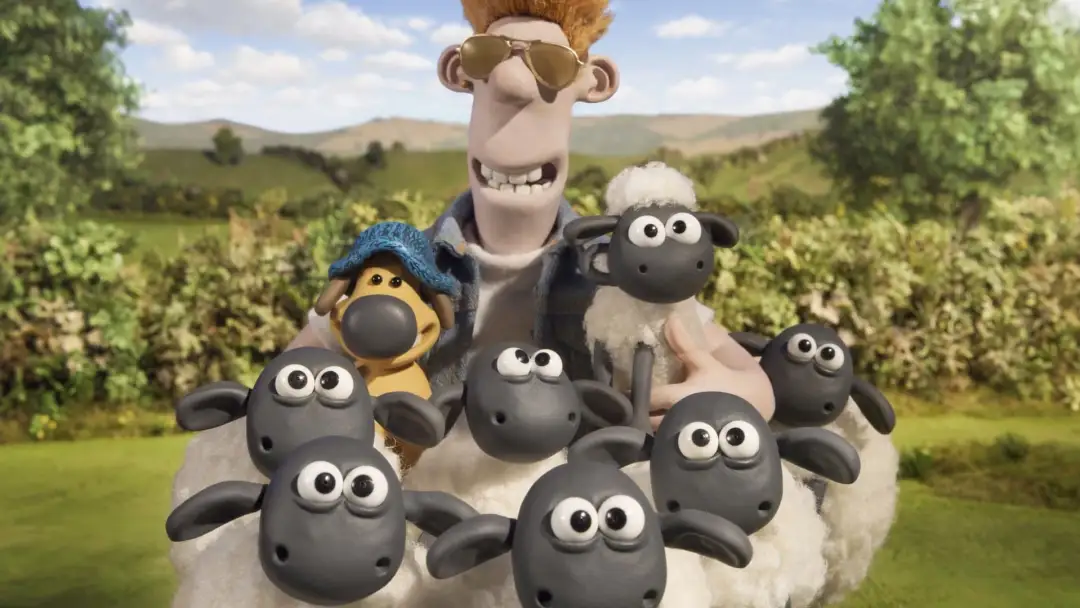
How Shaun the Sheep Movie makes you laugh without dialogue
From counting sheep to dining in disguise, Aardman’s 2015 film lets you spot the joke in a glance, a pause or a well-timed bleat.
In this article3 sections
There’s a point in Shaun the Sheep Movie when a flock of sheep needs a human to fall asleep. They have a fence, a willing line of jumpers and a very good idea of what people do when they count sheep. The joke starts as soon as you recognise the old bedtime trick. It gets better when you realise the sheep know it too. A whole plan has passed between the characters and the audience, and nobody has had to explain it.
That little exchange is a good way into Aardman’s 2015 film. Shaun’s attempt to get a day off sends the Farmer rolling away in a caravan and takes the flock into the Big City to find him. The scale changes considerably between the farm gate and the city streets. The film still asks the same thing of you: notice what a character thinks is ordinary, then look for the sheep who sees an opportunity in it.
Count the sheep and watch the Farmer
The fence gag gives the audience an unusually clear job. Once the pattern is established, you can glance away from the next jumper and check how the Farmer is getting on. That glance is part of the payoff. The sheep have to keep doing the same thing, and the human has to get sleepier. The fun is in following both at once. If the film rushed to the result, you’d understand the plan just as well, but you’d miss the pleasure of watching it work.
Richard Starzak and Mark Burton, who wrote and directed the film, talked to Den of Geek about developing it through storyboards, cutting them into a reel and trying out sound effects. A gag like the fence makes it easy to see what that process can test. How many repetitions let you get ahead of the character? How long can you hold on a reaction before the audience starts looking for something else? An animator can give a sheep a wonderful expression, but the cut has to give you a reason to look at it at that moment.
Try this on the next gag, too. Pick the person or animal who knows least about the plan and watch them for a beat. You may catch the moment the whole joke turns on a perfectly reasonable assumption. The Farmer has every reason to think he understands sheep. Shaun has the advantage of understanding the Farmer.
At the restaurant, the audience is in on it
In the city, the flock has to pass for people. The disguises help them get into a restaurant. Sitting down to eat gives them a much harder problem. There’s a small set of rules people at a restaurant are expected to follow without anyone stopping to explain them. What to do with your hands, when to look at the other guests, how long to stare at the food someone else ordered. A sheep may get a surprising number of those things right and still look terribly suspicious.
That’s the pleasure of the restaurant sequence. The waiting staff and other diners are dealing with a table of strangers. We get to see a flock trying to work out how a meal works when everyone is watching. If you open the clip below, pick one sheep and watch for the difference between looking around out of curiosity and looking around to see whether anyone noticed. A lot of the tension lives in that difference. You can laugh at the disguise first and still find a second joke in the little effort it takes to keep the disguise going.
Burton told Animation World Network that the city developed as the script did, and that the art director had trained as an architect. You can feel the value of giving the flock places with their own routines. A farm offers plenty of trouble for a sheep, but Shaun already knows where to look for it. In the city he has to read the room as quickly as we do. A restaurant is a particularly good room for the job because almost everyone else in it is trying to behave as if they know exactly what they’re doing.
Open the restaurant scene on YouTube
Listen for the moment a plan slips
The film has a busy soundtrack. Bleats, grunts, music and the noises objects make in the characters’ hands all have work to do. When two characters share a frame, a noise can send your attention to the one who just realised something. A pause can leave you watching the other character carry on, blissfully unaware. The jokes are easy to follow with your eyes, and those little shifts in attention give them much of their rhythm.
That makes this a lovely film to share with someone who doesn’t speak the same language as you, or with a younger viewer who wants to point out what’s happening before you do. Give them the chance. Two people on the same sofa can follow different sheep in a crowded frame and laugh a second apart. If you’re choosing it for that kind of evening, start with the 2015 film. Its opening teaches you what a normal day on the farm looks like, so the sight of the Farmer, the caravan and the hill suddenly makes you pay attention to where everybody is standing.
If you already know the film, try a quick listening test with a favourite scene. Watch the first few seconds with the sound down, then go back and turn it up. Notice whether you look in the same place just before the laugh. After a few seconds you may find yourself paying attention to the sound of a room full of people attempting to mind their own business. In this film, even a room pretending to be quiet can have a lot to say.
Editorial references
Sources
-
Shaun the Sheep movies
Accessed 2026-11-20
-
Richard Starzak & Mark Burton interview: Shaun The Sheep
Published/updated 2015-02-05 Accessed 2026-11-20
-
Aardman is Baaack in Cinemas with Shaun the Sheep Movie
Published/updated 2015-08-06 Accessed 2026-11-20
-
Review: Feast your eyes on the visual delights of Shaun the Sheep Movie
Published/updated 2015-08-04 Accessed 2026-11-20
More from Watchmora Journal

How A Knight’s Tale turns a joust into a stadium sport
From Queen’s opening beat to Bowie on the dance floor, A Knight’s Tale gives its crowds as much to do as its knight.
Read story
How the camera gets the joke in Abbott Elementary
Janine, Ava, Gregory and Barbara each give the documentary crew something different. Here’s what to watch for in the pilot and Wishlist.
Read story
How Parasite and Snowpiercer make class visible
Follow the stairs in the Parks’ house and the doors on Curtis’s train to see how Bong Joon Ho tells us who belongs where.
Read story
What to watch after Your Name
Go back to rain-soaked Tokyo with Weathering with You or follow Suzume through Japan. Choose your next Makoto Shinkai film by what stayed with you.
Read story