How a cookbook connects two kitchens in Julie & Julia
Watch the recipes move from Julia Child’s kitchen to Julie Powell’s blog, and see why a ruined dinner deserves as much attention as a beautiful one.
In this article4 sections
At some point in Julie & Julia, a pot of beef stew has to disappoint you. This is harder to arrange than it sounds. The person cooking for the camera is usually trying to make an audience hungry. Here, when Julie Powell falls asleep and leaves her boeuf bourguignon in the oven, the dish has to look like an evening’s work that cannot be saved. It helps to think of that ruined dinner when you decide whether to watch Nora Ephron’s film. The food looks good often enough. It also has the freedom to go horribly wrong.
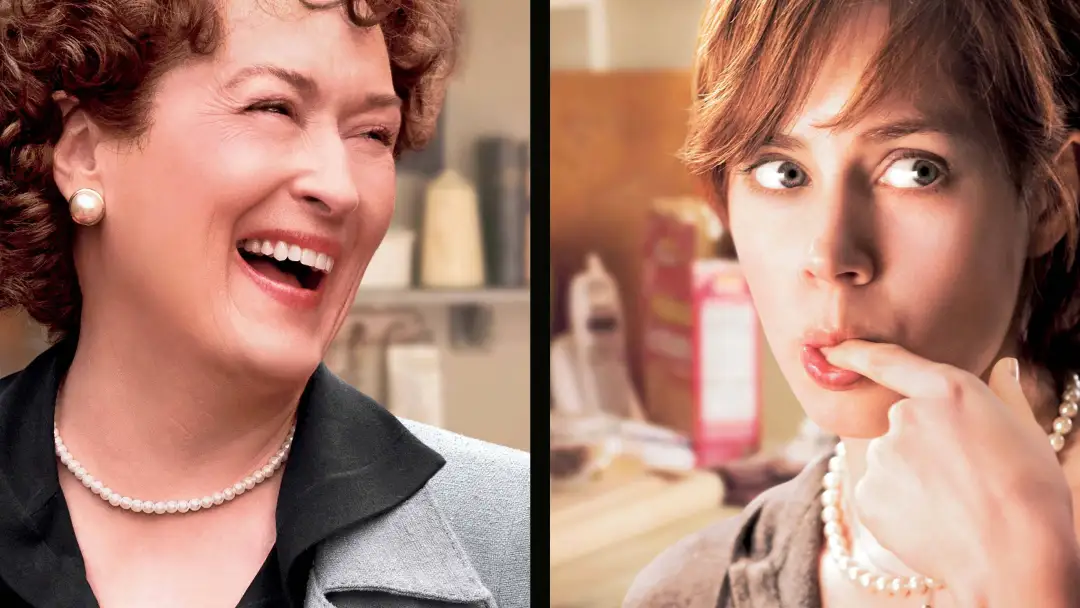
Ephron’s 2009 film puts Amy Adams’s Julie Powell and Meryl Streep’s Julia Child in two different periods. Julie sets out to cook 524 recipes in a year and writes about the attempt on a blog. In the other story, Julia learns French cooking in France and works towards the book that Julie will use. If you like the idea of a film about food but tend to lose interest once a dish has been served, follow the writing instead. One cook is trying to explain how to do something. The other has to find words for how trying it actually went.
Think of the book as a person who has left the room
When you learn from somebody at the stove, you can ask how brown an onion ought to be or whether the strange smell is normal. A recipe has to help with those decisions before its author knows who will make it or where. That is an interesting problem to bring to Julia’s half of the film. The classes, the practice and the work of putting knowledge on a page all have a future reader somewhere inside them. We get to meet one of those readers, with a different kitchen, a full-time job and a deadline of her own making.
Ephron told NPR in 2009 that when she cooked from Child’s book she sometimes carried on conversations with the author in her imagination. You can see the appeal. If a recipe has anticipated the question you are about to ask, it feels as if its writer has looked up and noticed you. If it hasn’t, even a good set of instructions can feel very far away. Julie’s project turns that private conversation into something other people can read. Those readers get a report on the day as well as the dish. The bad evenings can be worth writing about for exactly the reasons they felt awful to live through.
Watch what changes when the scene crosses decades
Ephron told The Washington Post that producer Amy Robinson suggested combining the stories. The film adapts writing by Julie Powell and by Child with Alex Prud’homme. You can take the structure as an invitation to compare a problem across two lives. Try looking for the next cut when one of the women is about to judge her work. Does the scene across the cut make the previous problem look simpler, or remind you of a difficulty the other woman hasn’t had to face yet?
The two duck scenes are a good reason to keep this in mind. Colin Flynn, who cooked for the production, told Smithsonian that both characters have a scene deboning a duck, and the actors really worked on raw ducks over multiple takes. If you want a particular action to follow, look at the hands for a few seconds. A cook can look entirely familiar with a task at the moment she sets about it. Watching a later cook work out what to do with the same animal gives the gesture another life. There is no requirement that the experience feel the same just because the task has the same name.
Notice when an ugly dish tells you more
Flynn said his team really burned the stew. He also described using choux pastry to represent a soufflé for a scene, because the pastry would keep its height through shooting. Put those choices beside each other. A production may need an actual burnt dinner so you recognise defeat without an explanation. It may also need a convincing stand-in when a real dish would stop looking the way the scene needs it to look. Both decisions begin with what the audience can learn in the few seconds the camera gives the plate.
There’s an easy test for a first viewing. When a dish appears, ask whose judgement matters. Sometimes it’s a character who has to eat it. Sometimes it’s the cook, who already knows how far the result fell short of what she pictured. Sometimes it’s us, reading a kitchen disaster before the cook has even taken stock. The more precisely the film tells us which moment we’re in, the less it needs a close-up of an admiring face to make food interesting.
Choose it for a story about making something in your spare time
Julie & Julia is a good evening for anybody who has opened an old book, taken up a project after work or given themselves a deadline that sounded considerably easier on day one. The film has room for the pleasures of eating and for the effort of keeping a project alive when it starts to take over the kitchen. If you watch with somebody, compare the moments when you most want to offer advice to one of the cooks. One of you might want to lift the lid on a pot. The other might want to tell Julie what to write about the evening she has just had. The distance between those two urges is a lot of what makes the film fun.
Editorial references
Sources
-
Julie & Julia
Accessed 2026-11-19
-
Nora Ephron On Julie, Julia And Cooking Like A Child
Published/updated 2009-08-07 Accessed 2026-11-19
-
The Chef Who Cooked for Julie & Julia
Published/updated 2009-08-12 Accessed 2026-11-19
-
Film’s Finest Foodie: Nora Ephron
Published/updated 2009-08-05 Accessed 2026-11-19
More from Watchmora Journal

How A Knight’s Tale turns a joust into a stadium sport
From Queen’s opening beat to Bowie on the dance floor, A Knight’s Tale gives its crowds as much to do as its knight.
Read story
How the camera gets the joke in Abbott Elementary
Janine, Ava, Gregory and Barbara each give the documentary crew something different. Here’s what to watch for in the pilot and Wishlist.
Read story
How Parasite and Snowpiercer make class visible
Follow the stairs in the Parks’ house and the doors on Curtis’s train to see how Bong Joon Ho tells us who belongs where.
Read story
What to watch after Your Name
Go back to rain-soaked Tokyo with Weathering with You or follow Suzume through Japan. Choose your next Makoto Shinkai film by what stayed with you.
Read story