How A Knight’s Tale turns a joust into a stadium sport
From Queen’s opening beat to Bowie on the dance floor, A Knight’s Tale gives its crowds as much to do as its knight.
In this article4 sections
Before you have much reason to care who wins a joust in A Knight’s Tale, the people in the stands give you a reason to care that it’s happening. They stamp and clap along to Queen’s “We Will Rock You.” The beat is simple enough that you can practically join in from the sofa. In a few seconds, a contest with unfamiliar rules feels like the biggest game of the weekend.
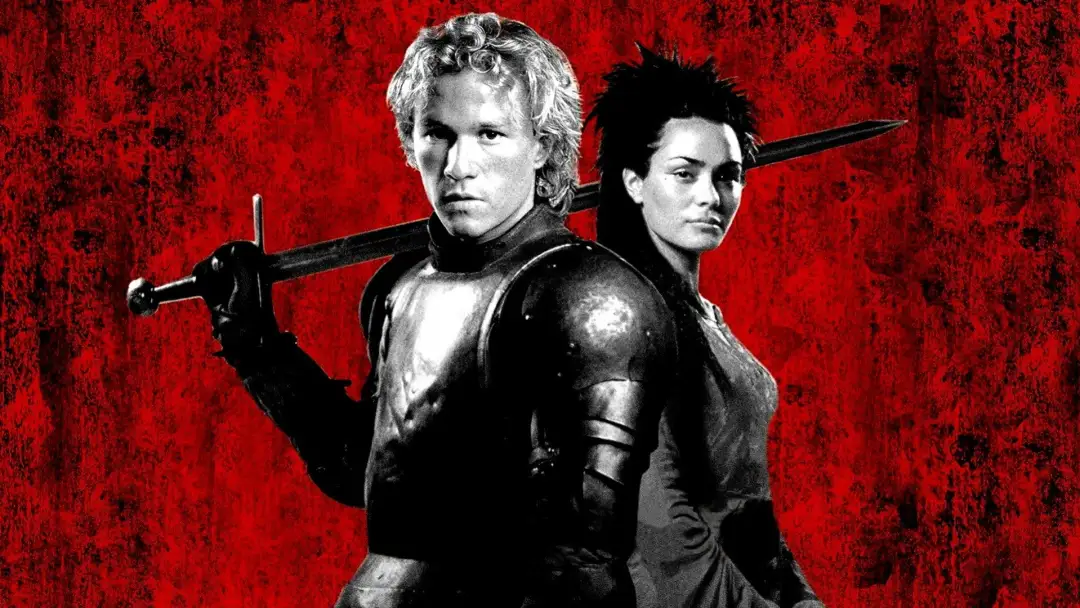
Brian Helgeland’s 2001 adventure follows William Thatcher (Heath Ledger), a squire who passes himself off as a nobleman to compete. It has the pleasures of a sports movie, from the shaky practice sessions to the teammate who knows how to get everyone going. Its sharpest idea is that William has to win over several audiences, and that each audience decides what counts as a convincing performance. The crowd wants a show. The people who run the tournament want a pedigree. A roomful of dancers wants to see if he can keep up.
Queen gives the spectators something to do
Put a rock song over a joust and you can give the riders a little extra swagger. Give the rhythm to the people watching, and suddenly they have a part in the scene. You can see bodies moving together. There’s enough silence between the beats for the next one to feel like an appointment everyone intends to keep. The filmmaking lends the crowd the authority of people who know exactly what they came for. That’s reassuring when you’re new to the sport, as most of us are.
Helgeland wrote about the idea in the Los Angeles Times. Research led him to the premise of a skilled young man barred from competition by birth. His research gave him the rules of William’s world, but the director reached for the music of his own youth to imagine how it felt to be young in it. That decision puts spectators with faces and elbows and a sense of occasion in a setting that could easily have been all castle walls and insignia.
On a rewatch, try looking at the stands during the opening rhythm. It’s a neat way to see how two kinds of belonging can exist at the same event. You can take part from the benches by picking up the beat. Entering the lists as a competitor involves a very different set of rules. The whole story fits inside that difference.
Chaucer tries to get a cheer from scratch
Queen starts with a rhythm people are already sharing. Geoffrey Chaucer, played by Paul Bettany, has the harder job of building a response when nobody knows what to make of the man he’s introducing. He becomes William’s herald and gives this unknown competitor the kind of billing a boxing announcer might give a sellout bout. Bettany can make a long buildup funny by sounding as if every fabulous detail is indispensable. The stranger the praise gets, the more curious you become about the person who has to ride out and live up to it.
There’s a wonderful hesitation after one early speech, when Roland, played by Mark Addy, starts the applause himself. Addy told The Ringer that the extras hadn’t realised they were meant to respond to Bettany’s speech in English, so he took the lead and Helgeland kept it. The pause does a lot of work. You hear what it costs to stick your neck out for a friend in front of strangers. From the safety of the stands, everyone can wait for someone else to decide whether this is worth cheering.
The friends put in plenty of work away from the crowd, too. Sony’s training clip catches Roland and Wat trying to get William ready. If you enjoy the scruffy middle of a sports story, when a team is still figuring out what it can do, this is a good taste of the film. Watch the helpers as much as the man in training. Here you can see the team from the practice yard, before Chaucer gets the chance to make it sound magnificent.
At the dance, listen for Bowie arriving
For a different kind of performance, follow William out of the arena and onto the dance floor. Composer Carter Burwell explains that the choreography had already been filmed to a tempo that gradually sped up. He had to make his courtly music follow that acceleration and land on David Bowie’s “Golden Years.” With permission to work from Bowie’s multitrack recording, he could mix elements of the song into the arrangement ahead of the handover. Tony Visconti, the original song’s producer, supervised the remix session.
That’s a good reason to listen closely before you recognise the song. You can catch a gathering getting more comfortable with itself while the music changes under its feet. William needs help here as well. Kate, the blacksmith played by Laura Fraser, teaches him to dance. A tournament hero might look self-sufficient from the far side of the rail, but here the film gives us a chance to appreciate the work behind a few confident steps. Even the person everybody is watching has company.
Who should put it on?
Pick A Knight’s Tale if you want a period adventure with the bustle of a game day and room for its supporting players. Ledger has the face you’d put on the poster. Addy, Bettany, Fraser and Alan Tudyk give you reasons to look just outside the centre of the frame. The romance and the formal dance give the story room to change pace. If you’re putting it on with friends, the opening makes an excellent test. Anyone already tapping along has found their seat.
Editorial references
Sources
-
A Knight’s Tale
Accessed 2026-11-23
-
A Knight’s Tale – Carter’s Notes
Accessed 2026-11-23
-
A Write Knight Takes on Hollywood—and Lives to Tell the Tale
Published/updated 2001-05-14 Accessed 2026-11-23
-
Late Nights With Heath Ledger: Stories From the Set of ‘A Knight’s Tale’
Published/updated 2021-05-11 Accessed 2026-11-23
-
‘Knight’s Tale’: Surely They Joust
Published/updated 2001-05-11 Accessed 2026-11-23
More from Watchmora Journal
How the camera gets the joke in Abbott Elementary
Janine, Ava, Gregory and Barbara each give the documentary crew something different. Here’s what to watch for in the pilot and Wishlist.
Read story
How Parasite and Snowpiercer make class visible
Follow the stairs in the Parks’ house and the doors on Curtis’s train to see how Bong Joon Ho tells us who belongs where.
Read story
What to watch after Your Name
Go back to rain-soaked Tokyo with Weathering with You or follow Suzume through Japan. Choose your next Makoto Shinkai film by what stayed with you.
Read story
Where to start with the modern Planet of the Apes
Start with Rise to follow Caesar, or jump to Kingdom to explore Noa’s world. A spoiler-free guide to choosing your route through the four modern films.
Read story