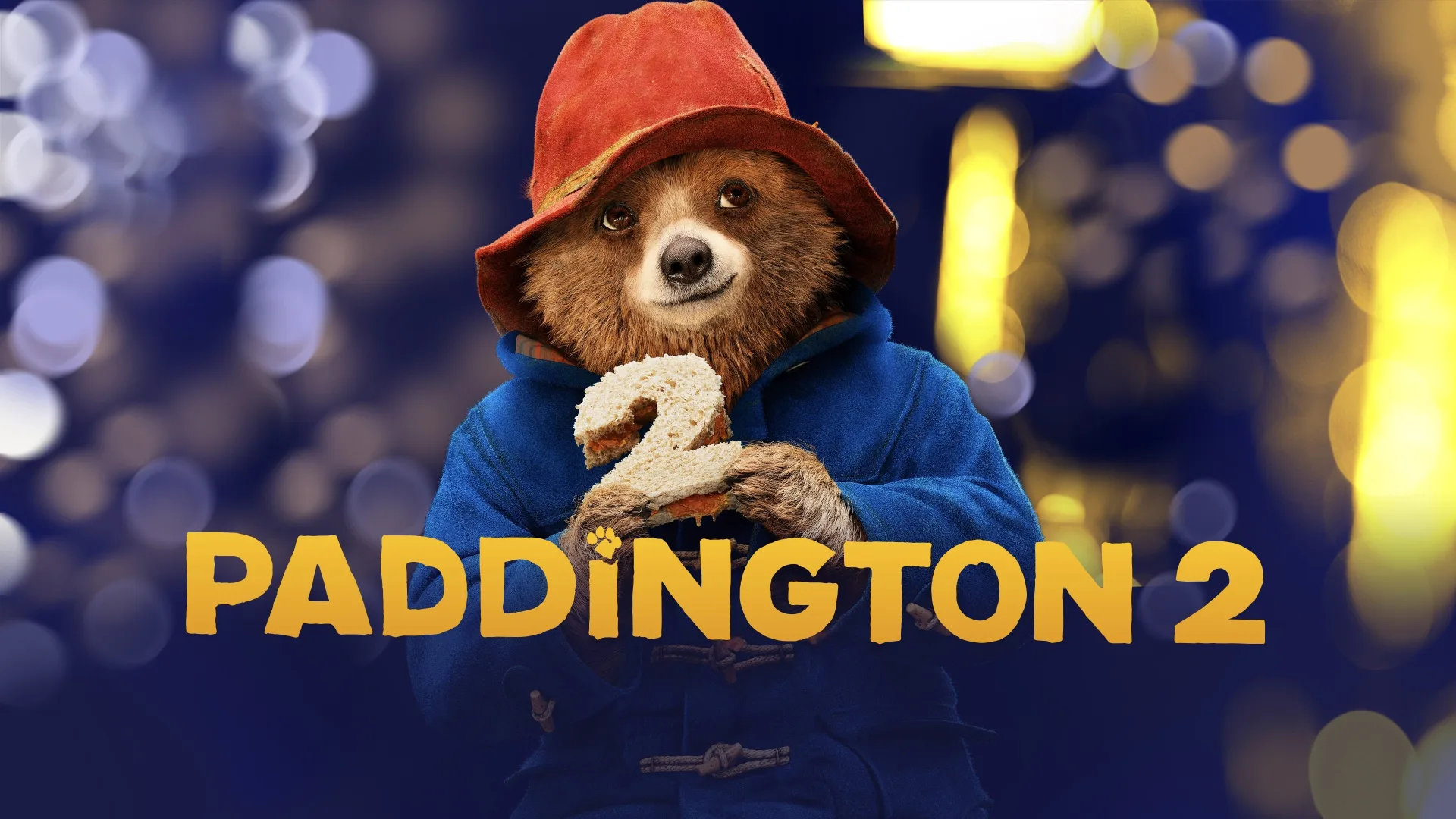
How Paddington 2 folds London into a birthday present
A folding bridge, a bus with a wheel problem and a bear who knows the way. Inside Paddington’s paper tour for Aunt Lucy.
In this article4 sections
Suppose you had one page on which to show somebody your town. Would you put the station on it, so they could imagine arriving? The enormous building that makes everybody look up? Or the corner where you would wait for them, because the point of the trip was always to meet? Paddington finds a book full of London landmarks in Mr Gruber’s shop. What makes it worth saving up for is an addition the printer could never have supplied. He can picture his aunt there with him.
In Paul King’s Paddington 2, the bear wants a birthday present for Aunt Lucy. A pop-up book catches his eye, and for a little while the film lets the two of them travel through its pages. The book’s theft sets the larger story going. You can enjoy this early detour without knowing how that story turns out. It offers a particularly nice reason to pick the film for a mixed-age afternoon. Someone who loves making things and someone who wants to be taken somewhere can sit through exactly the same sequence and come away with quite different souvenirs.
Start with the hinge
Remember opening a pop-up card a little too cautiously? Halfway open, the scene looks faintly embarrassing. A tower leans over, something catches, a roof wants another centimetre. Then your hands move just far enough apart and a whole arrangement of surfaces suddenly reads as a place. That small interval is a pleasure peculiar to paper. The person looking at the picture gets to bring it into being.
David Hawcock’s team made physical books for the production and worked with the effects team on the imagined tour. There is a lovely complication in the shop. The Tower Bridge that unfolds as Paddington opens the book there is digital. The artists had to match the behaviour of its physical counterpart, which appears elsewhere in the film. Being able to build a bridge on a computer would only get them halfway. They had to make one that looked as though your hands could close it again.
Watch the bridge on those terms. First look at the width it occupies when it stands up. Now try to guess where all that width would go if the two covers met. Even a wrong guess gives the next page turn a little suspense. A child can have a perfectly good time finding the bridge; the person who has spent years fixing torn birthday cards may be the one leaning forward.
Take the bus apart in your head
A double-decker bus sounds like a modest assignment once you have built Tower Bridge. Give it wheels, paint it red, send it along the street. But a working vehicle and a working pop-up demand two different jobs of the same wheel. It has to turn while the bus is travelling. It must also go somewhere sensible when the bus folds. In VFX Voice, the crew singled out the difficulty of getting those motions to agree.
Imagine a little paper bus of your own. Draw a wheel on the side and the whole thing will flatten beautifully; good luck getting that wheel to spin. Pin on a separate disc and it will spin, but now there is an extra thickness to accommodate when the card shuts. Nobody needs to solve the toy to follow the movie. What the thought experiment gives you is a second way of enjoying its traffic. There are vehicles here with an obligation to their passengers and a separate obligation to the binding.
The artists allowed themselves leeway for some folds once they were further inside the fantasy. It would be a shame to spend the outing checking every crease for engineering errors. Notice instead how quickly the bridge earns your trust. Once one landmark has demonstrated the rules in a place as ordinary as a shop, the film has a surprising amount of credit to spend.
Who shows whom around?
Think of the difference between visiting a city with a guidebook and visiting with a friend who lives there. The guidebook can tell you where a cathedral stands. Your friend might lead you down a longer street so that you meet it from the best angle. In Paddington’s London, turning the page gives the bear something like that second privilege. A building can rise just as his guest arrives. There is no need to hurry Aunt Lucy along or ask her to turn back because she has missed the view.
Framestore describes fitting the camera’s movements around the turning pages. It is worth imagining the opposite arrangement: a camera hurrying straight to a famous sight, with paper scenery popping upright behind it to catch up. You would probably remember the building. Here you have a chance of remembering the introduction. For a few seconds a bear who would like to buy a book gets to be the person who knows the way.
That is why the price of the present matters even though we never need a lesson in what antique books cost. Consider the perfectly sensible substitutes an adult might suggest. A postcard can travel. A photograph will show more detail. Paddington has already tried this particular gift in his imagination, however, and found room for two. Once we know that, the prospect of losing it has a much sharper edge.
A question to take home
After the film, give each other one imaginary spread. Choose a place you know well and decide what ought to stand up first when someone opens it. Leave the postcard views to one side for a minute. Perhaps a railway footbridge matters because you could always see who was coming. Perhaps the smallest kitchen in the family deserves an absurdly large paper table because that is where everybody ended up.
Now name the person you would open it for. If changing that person changes the page, you have a pretty good idea of what Paddington saw in the shop. It takes a remarkable number of skilled people to fold a city into a book. It takes a particular reader to find a birthday present there.
Editorial references
Sources
-
Paddington 2 — visual effects and storybook design
Accessed 2026-11-15
-
Paddington 2 — paper engineering
Published/updated 2019-09-25 Accessed 2026-11-15
-
Inside Framestore’s Paddington 2 Pop-Up-Book Sequence
Published/updated 2017-12-20 Accessed 2026-11-15
More from Watchmora Journal
How A Knight’s Tale turns a joust into a stadium sport
From Queen’s opening beat to Bowie on the dance floor, A Knight’s Tale gives its crowds as much to do as its knight.
Read story
How the camera gets the joke in Abbott Elementary
Janine, Ava, Gregory and Barbara each give the documentary crew something different. Here’s what to watch for in the pilot and Wishlist.
Read story
How Parasite and Snowpiercer make class visible
Follow the stairs in the Parks’ house and the doors on Curtis’s train to see how Bong Joon Ho tells us who belongs where.
Read story
What to watch after Your Name
Go back to rain-soaked Tokyo with Weathering with You or follow Suzume through Japan. Choose your next Makoto Shinkai film by what stayed with you.
Read story