Why the second sprint feels faster in Run Lola Run
A dog on the stairs, a woman with a pram and twenty minutes on the clock. A spoiler-light guide to what changes when Lola takes the same street again.
In this article4 sections
There is a woman pushing a pram in Berlin. From her point of view the interesting thing about this morning might be how the baby slept, or whether she remembered her keys. From Lola’s point of view she is someone occupying a few crucial inches of pavement. Then the film gives the woman a sequence of photographs from her possible future. For a few seconds the person with the least urgent business in the frame has a future we’re desperate to know more about. Meanwhile, a young man across town is still waiting for his money.
That change of allegiance is a good reason to try Tom Tykwer’s Run Lola Run. The German thriller from 1998 takes a stretch of twenty minutes for three different runs through Berlin. You might expect a story to lose a little urgency each time it goes back to the start. Here, recognizing a stranger can make the second trip through a street considerably more nerve-racking than the first. This guide gives away the shape of the movie and leaves the outcomes of all three runs alone.
The phone call gives you just enough to go on
Manni is a courier. He has lost 100,000 German marks, his boss expects the money in twenty minutes and Lola is the person he calls. Think how much time another thriller could spend introducing the boss, explaining the job and establishing exactly how dangerous it is to come up short. Tykwer can get by on the sound of a man calling someone he loves because he has run out of ideas. If you’ve ever had to calm somebody down over the phone while trying to get one useful piece of information out of them, you already have a way into the scene.
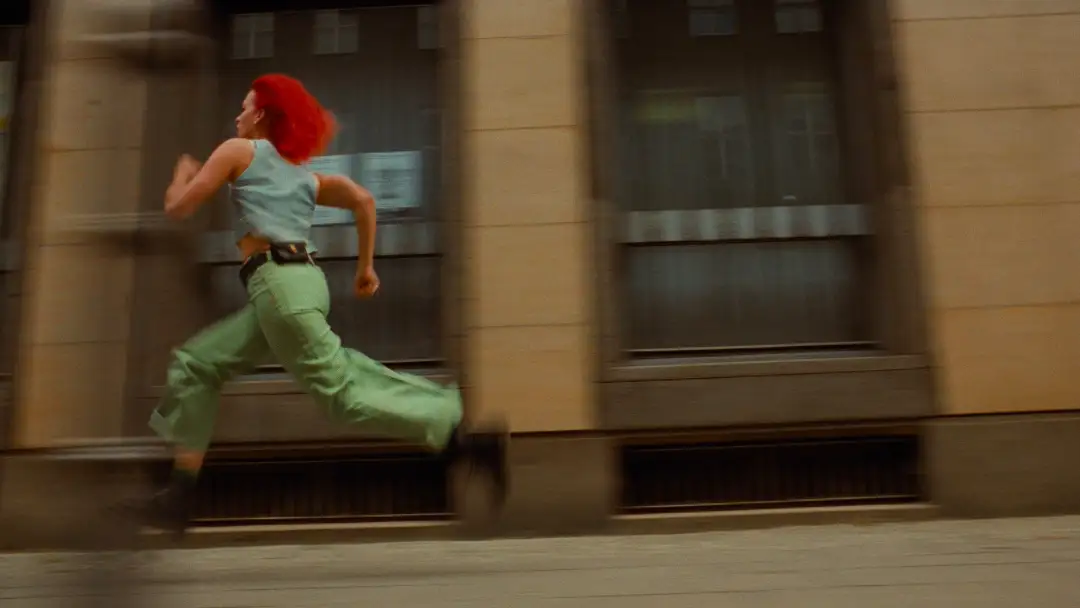
The practical difficulty is almost comically large. Imagine hanging up that call. You could probably come up with the name of someone to ask for help. Would that person be home? How long would it take to reach them? Lola’s first great advantage as a screen character is that Franka Potente can make setting off at a sprint look like a perfectly sensible answer while the rest of us are still standing beside the phone. Potente later told the Associated Press she would think twice about the bleaching it took to get that red hair. On screen the colour earns its keep. Your eye can pick her out before you have time to get your bearings. A city you don’t know becomes navigable so long as you keep sight of one moving person.
Why it helps to recognize the stairs
Watch what you do the first time the film sends an animated Lola down a staircase. You’re probably busy adjusting to the fact that she’s a drawing. There’s a man and a dog to register, a flight of steps to get down, a cut back to the live-action world. By the time you’ve taken all that in, the film has gone round the next corner. The next time the stairs appear, you know the layout. Suddenly there’s room in your attention for a much smaller question. How is she going to get past the dog this time?
It’s the difference between your first morning walking to a new job and your fifth. On Monday you’re looking for the street name. By Friday you know which crossing costs you a minute if you miss the light. The walk hasn’t grown more complicated. You’ve grown better at reading it. That’s a small gift a repeating story can give its audience. It gets to turn us into locals in a remarkably short time. A change that would have required a great big explanatory close-up on the first trip can register almost in passing on the next.
A whole other film in a handful of photographs
For a change of pace, give one passer-by your attention. When Lola crosses paths with certain strangers, a burst of still photographs leaps ahead in their lives. There’s a peculiar pleasure in how much storytelling this asks you to do. A face has aged, someone else is beside it, the setting has changed. You hardly have time to invent the years that connect the pictures. The next thing you know you’re back on the pavement, needing to catch up with a runner who hasn’t had the benefit of seeing any of it.
That gap between what she knows and what we know gives the race an unexpected tenderness. Lola has every reason to hurry past the woman with the pram. We have been given reason to wonder what happens after the woman pushes it out of sight. Try keeping an eye out for her when the route becomes familiar. Knowing she has a life elsewhere makes it much harder to dismiss her as part of the scenery. And when a new set of pictures arrives, there’s the strange sensation of missing a possible future you spent only seconds getting to know.
Who to take along for the run
For someone who likes a puzzle, there’s fun in tracking a single encounter across all three passes. For the friend who would sooner go dancing, there’s the insistent electronic beat. It keeps going across changes of picture and place, so you can lose the precise chain of events for a moment and still feel where the film wants to take you. Fast cutting and the rush of still images are part of that experience. Save it for an evening when you feel like giving a film your eyes as well as your ears.
If you watch it with somebody, compare the moment you each began to anticipate something. One of you may have been waiting for the dog. The other may have lost interest in the money for an instant and wanted to stay with a stranger. Both of you have been running on the same twenty-minute clock. It’s rather lovely how little that tells you about where you’ve been.
Editorial references
Sources
-
Run Lola Run
Accessed 2026-11-17
-
Film Notes: Run Lola Run
Published/updated 2023-11-01 Accessed 2026-11-17
-
Tom Tykwer and Franka Potente on Run Lola Run
Published/updated 2024-06-04 Accessed 2026-11-17
More from Watchmora Journal

How A Knight’s Tale turns a joust into a stadium sport
From Queen’s opening beat to Bowie on the dance floor, A Knight’s Tale gives its crowds as much to do as its knight.
Read story
How the camera gets the joke in Abbott Elementary
Janine, Ava, Gregory and Barbara each give the documentary crew something different. Here’s what to watch for in the pilot and Wishlist.
Read story
How Parasite and Snowpiercer make class visible
Follow the stairs in the Parks’ house and the doors on Curtis’s train to see how Bong Joon Ho tells us who belongs where.
Read story
What to watch after Your Name
Go back to rain-soaked Tokyo with Weathering with You or follow Suzume through Japan. Choose your next Makoto Shinkai film by what stayed with you.
Read story