How Klaus tells its Christmas story with light
The postman in shadow, a coat that catches the light and a street that looks more inviting. Three details to follow in this animated Christmas film.
In this article4 sections
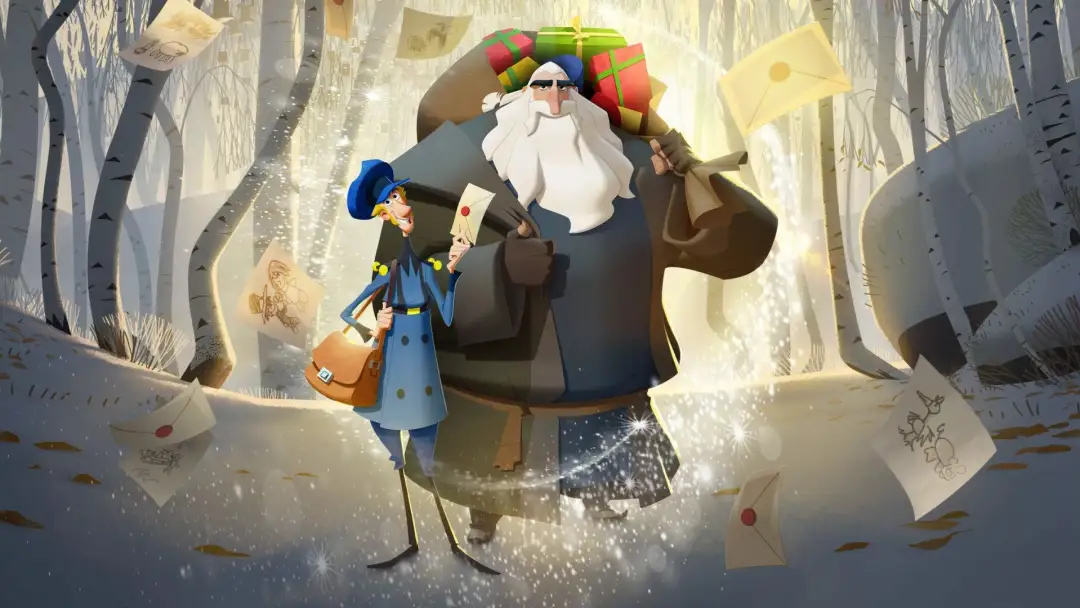
In Klaus, a postman starts dealing with children from the shadows. He offers a very attractive exchange. Write a letter and there might be a toy in it for you. For the children, that is reason enough to find a pencil. For Jesper, it is a way to get people to use the post. Watch where the film puts him during this pitch. He tends to stay on the dark side of the picture. You can follow his business plan by listening to him. Looking at his face gives you a better idea of how much to trust him.
That is a good way into Sergio Pablos’s 2019 Christmas film, especially if you are watching it with someone who knows the Santa story by heart. Look for who gets the light and what they are trying to do. A little change in brightness can give away a motive, leave room for a joke or draw attention to a person who was easy to overlook before. You only need the early premise. An ambitious postman has been sent to the quarrelling town of Smeerensburg. A reclusive toymaker lives nearby. The two are about to give the town something new to talk about.
A toy looks different depending on who wants it
Think of the offer from each side. A child can see a toy at the end of the transaction. Jesper can see a letter. The same act means something different to each of them, and the joke works because the child’s excitement is real. So is Jesper’s relief at finding an angle. If you have ever volunteered for a task because it also solved a problem of your own, you probably know how neatly those motives can fit together.
Pablos pointed out the shadow during the letter pitch in an interview with Awards Watch. It is an especially useful scene to look for because the lighting gives you information so quickly. You can ask what would happen if the picture were lit evenly. The same words would get across, but the invitation might look innocent. The shadows let Jesper look as though he has something to hide even while he is being wonderfully persuasive. That little tension makes it easier to laugh with the film while staying sceptical about him.
Start by watching the edges of a coat
Try drawing someone’s face on a scrap of paper. Put an edge on the nose, give the cheek a line and then hold the page beside two lamps of different colours. You have changed the light falling on the paper. Nothing has changed about the light in the little world you drew. Getting that character to look as if they live beside a particular window or fire takes another set of decisions. How much of the cheek is lit? Where does the shadow begin? Will we still recognise the expression?
The team on Klaus made those decisions on top of drawn performances. Production designers Szymon Biernacki and Marcin Jakubowski described an approach to SIGGRAPH in which artists could see the light they were painting and make its layers follow the animated characters. The movie also uses some three-dimensional elements, including props. A good thing to look at is the edge of a face or coat when it turns. An outline carries much of the pose. The shapes of light inside it can suggest how the figure is turned and where it stands in relation to the room.
That attention to an edge is useful because you can try it briefly, then get back to the action. Choose a shot where someone is hard to read. See whether you need to see both eyes to know how the character is feeling. Sometimes you get more from the shape of the shoulders, or the time it takes for a head to turn. Lighting can direct you to one part of a performance and leave you to guess at the rest.
Check what the street asks of its neighbours
Pablos described giving his designers a town that would eventually look like a place people wanted to spend Christmas. They began by figuring out how far away from that it could feel. That suggests a practical test for the opening Smeerensburg scenes. Pick a street and imagine being the person expected to carry a letter from one end to the other. Where would you ask for directions? Where would you wait for somebody? Would you knock a second time if the first knock went unanswered?
You can track the change in that answer without keeping a tally of plot points. As Jesper’s route brings the residents into contact, pay attention to what happens around the people speaking. A doorway can feel like a defence or a place to linger. A bright patch can draw you toward the activity happening there. Scale is part of it too. In a place that makes a solitary walker look small, finding two people willing to stop and talk can feel like a sizable event.
Open the official trailer on YouTube
Let two viewers notice different things
Choose Klaus for a winter evening when you want a comedy with room for an initially prickly friendship. There is quarrelling and menace alongside the toys. Part of the pleasure is that the town has plenty of warming up to do. An animation fan can follow the changing light on a character’s face. A younger viewer can decide whether they would trust Jesper’s offer. If you watch together, each of you can pick a moment when someone on screen made a street, doorway or room feel easier to walk into. Compare your choices after the film. You may find that one of you was listening to a character while the other was watching everything change around them.
Editorial references
Sources
-
Klaus
Accessed 2026-11-18
-
Behind the Magic of Netflix’s Klaus
Published/updated 2019-12-12 Accessed 2026-11-18
-
Interview with Klaus director Sergio Pablos
Published/updated 2019-12-16 Accessed 2026-11-18
More from Watchmora Journal
Who gets to build in Halt and Catch Fire?
A dismantled toy and a busy chat room show where to look for the real story in AMC’s drama about building computers and companies.
Read story
How A Knight’s Tale turns a joust into a stadium sport
From Queen’s opening beat to Bowie on the dance floor, A Knight’s Tale gives its crowds as much to do as its knight.
Read story
How the camera gets the joke in Abbott Elementary
Janine, Ava, Gregory and Barbara each give the documentary crew something different. Here’s what to watch for in the pilot and Wishlist.
Read story
How Parasite and Snowpiercer make class visible
Follow the stairs in the Parks’ house and the doors on Curtis’s train to see how Bong Joon Ho tells us who belongs where.
Read story